
Scarring Explained
Scarring occurs when the body rapidly seals a wound to prevent infection or bleeding, driven by active fibroblasts—the foundation of all scars. In the final phase of scarring, Remodeling (Up to 2 years after the scar has closed), fibroblasts decline, blood vessels close, and collagen hardens. This stage can produce varied scar outcomes. Proper mitochondrial management enhances blood and nutrient flow that promote skin beautification. Without it, complications may arise—see example below:
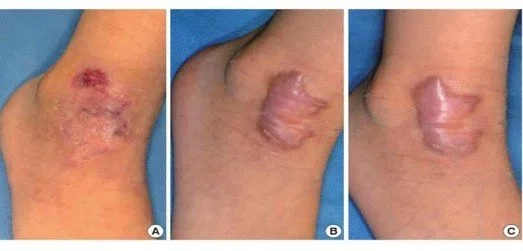
At point A, the scar is closed; but at point B (3 months) the scar has Keloid and more so by point C (6 months). Clearly, during Remodeling, blood and nutrient exchanges did not sufficiently occur resulting in less beautification of the skin.